Onelios is a free website builder for garage door companies: its AI drafts your site from your business name, what you do and your city, you see the draft before publishing, and each quote request and appointment request lands in one dashboard, with an email alert attempted for each.
Researched by the Onelios team at KCF LLC (about us) from the primary sources listed at the end of this page. Checked . A summary to help you check your own rules, not legal advice.
Free to build and publish. No card. See what is included
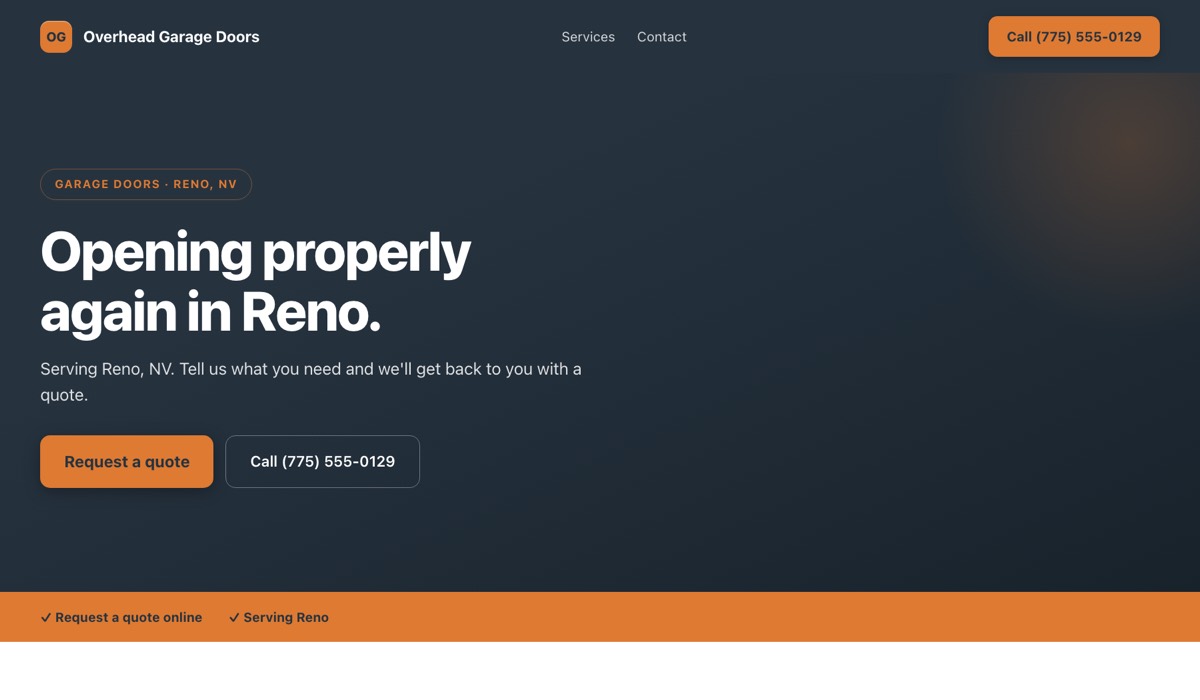
What Onelios does for you
- Your website: Answer three questions — business name, what you do, your city — and the AI drafts a home page starting from six services: springs, openers, off-track and cable repair, new doors, panels, and safety inspections. Keep the ones you do and read every line before publishing.
- A page per job: Type a title such as “Broken garage door spring replacement” and Onelios writes a page with an intro, what's included, common questions and a Request a quote button, then links it from your home page.
- Requests: A quote form on every site, and appointment requests once you save your hours, each held until you confirm it. Every request is saved in your dashboard, and an email alert to you is attempted.
- Reviews: Review requests go out by email and the customer writes the review, which appears on your site. Save your Google review link and, after writing it, they are offered a button to post it there too. No text messages.
- Monday email: How many quote requests, bookings and reviews your site received that week, what happened on your account, a few suggestions and one thing worth your time. Phone calls and texts are not counted.
What pages does a garage door website need?
A garage door website needs a home page with your phone number at the top, the repairs and installations you do, and the towns you cover; a page for each job people look for, such as spring replacement or opener repair; your license number where your state requires it; photos of your own doors; reviews; and a quote form.
Onelios starts a garage door site with six services: spring repair and replacement, opener repair and installation, off-track and cable repair, new door installation, panel and dent repair, and a safety inspection and tune-up. You keep the ones you do. With a phone number saved, a Call button sits in the top bar of the home page and the line above the quote form adds “Or call” with your number. A gallery appears once you upload photos, and a reviews section once you have reviews.
Each extra page is written by the AI from its title, your business name, trade and city. It gets an intro, a “What's included” list, common questions and a Request a quote button, and is linked from your home page. You cannot edit that page afterward, only remove it and ask again. The AI is instructed not to add prices, guarantees, credentials or response times you did not give it, and it can still make mistakes, so read each page. The facts only you know — your license number, the spring rating you fit, the door brands you install — belong in the parts you type yourself: the line under your headline (up to 240 characters) and the line under each service (up to 220).
Title each page the way a customer describes the problem: “Garage door spring replacement”, “Garage door opener repair”, “Garage door off track”, “New garage door installation”. Keep to jobs rather than towns: Google's spam policies, updated August 28, 2026, give pages “targeted at specific regions or cities that funnel users to one page” as an example of doorway abuse, so name the towns you cover in the line under your headline instead. The free onelios address is kept out of Google on purpose; on a domain you already own, the same pages can appear in Google, though when and where is Google's decision.
Free to build and publish. No card. See what is included
What should a garage door website say about your license?
A garage door website should show what your state requires, and in California that means your license number. Section 7030.5 of the state's Business and Professions Code requires it in all forms of advertising, and the contractor board's guide counts any website that solicits business. The board's D-28 classification covers garage door work.
California's contractor board describes a D-28 contractor as one who “installs, modifies or repairs all types of residential, commercial or industrial doors including overhead or sliding door assemblies”. Since January 1, 2025, a person without a license may take a job under $1,000 only if it needs no permit and they employ nobody on it, and their advertising must say they are not licensed. A licensed company that shows its number is showing a customer the difference.
Other states set their own rules, so check what yours requires. For credentials specific to the trade, the Institute of Door Dealer Education and Accreditation (IDEA) offers a Residential Installer Certification and a Door Dealer Accreditation, and its site lets anyone look up accredited dealers and certified technicians, so a customer can confirm a credential you name.
Type your license number into the line under your headline yourself. The AI is instructed not to write license numbers or certifications you did not give it, and pages it adds from a title do not carry the number. If you ask the AI to rewrite your wording in a different tone, check afterward that the number is still there.
What should a garage door safety inspection page say?
A garage door safety inspection page should say automatic home openers fall under federal rule 16 CFR part 1211, and that the reversing feature needs a monthly test. The Consumer Product Safety Commission urged that test in 1992, when its rules for openers made from 1993 called for an electric eye, a door edge sensor or a hold-to-close button.
The rule comes from the Consumer Product Safety Improvement Act of 1990, which made the entrapment-protection requirements of the UL 325 standard a federal rule. The Commission codified them in 1991 and has revised the rule several times as UL updated the standard, including a direct final rule published in the Federal Register on March 14, 2024. Its 1992 advice was to test the reversing feature monthly and, if the door fails to reverse, to adjust it by the owner's manual or have a professional inspect it.
That gives an inspection page something concrete to offer before anything breaks. Title it plainly, such as “Garage door opener safety inspection”, and put the monthly test in your own words on the safety inspection line of your home page, because a page written from a title may not mention it. Say what you check rather than promising the door is safe.
Springs deserve the same plain warning. Clopay's homeowner guide says both torsion and extension springs are under extreme tension and that hiring a qualified professional is the safest route for spring replacement. Quoting a manufacturer makes that point without it sounding like a sales pitch.
How do you explain a garage door spring quote?
Explain a garage door spring quote by naming the spring's cycle rating: the open-and-close cycles it is built for. Amarr, a door manufacturer, says residential springs are 10,000-cycle springs, and Clopay puts the average door at about 1,500 openings and closings a year. A quote that states its rating can be compared; one without it leaves the customer guessing.
The industry specification for sectional doors, ANSI/DASMA 102, defines one cycle as the door moving from closed to fully open and back to closed. Amarr's guide adds that at up to three or four uses a day, springs should last at least seven years with the right maintenance. DASMA's technical sheet on spring life lists handling, installation, harsh climate, corrosion and missed lubrication as things that shorten it, so a rating is a design figure, not a promise.
If you fit higher-cycle springs as standard, say so and give the number. If you replace both springs when one breaks, say that and say why. Put it on the spring repair line of your home page in your own words, so a customer holding two quotes can see what the other one left out. The AI is not told which springs you fit, so only you can add that.
How do urgent garage door calls reach you?
Urgent calls need your number at the top. Google's Local Services Ads rules call garage doors an urgent category, because customers often call for time-sensitive needs “such as a garage door that won't open or close”. On an Onelios site with your number saved, a Call button sits in the top bar of your home page.
The same Google rules require background checks on the business, the owner and the service professionals before a garage door company can run Local Services Ads, and Google Ads in the United States requires advertisers of garage door repair services to apply for its advanced verification. Onelios does not run ads for you and plays no part in either check. What it controls is the site a caller lands on, so put your number, your license and photos of your own work there.
Appointment requests start once you save your working days, hours and time zone. A customer picks an open start time within the next two weeks, later today included if a time is left, and nothing is booked until you confirm. One appointment length applies to every job, the same start time cannot be requested twice, and overlapping jobs and outside calendars are not checked. There are no text messages and no reminders.
Each quote request and appointment request is saved in your dashboard, and Onelios tries to email you about each one; check the dashboard as well, because an email can fail or arrive late. Reply to the alert and your answer goes to the customer when they left an email address. A customer who left only a phone number needs a call back.
What should a new garage door page show?
A new garage door page should show doors you installed on real houses, the styles and brands you fit, and, if you want a number, Zonda's Cost vs. Value report. Its 2025 edition ranked garage door replacement first of the 28 projects it tracks for the second year running, recouping 267.7% of a $4,672 national-average job cost at resale.
Zonda's release of September 18, 2025 gives $12,507 as the national-average value at sale, worked out in part from surveys of real estate professionals and data from Verisk's XactRemodel. On September 23, 2026 the report's own address still led to the 2025 edition, so check for a newer one before quoting it. Name the source and the year, and do not present a national average as a promise about one house.
Upload JPEG, PNG or WebP photos from your phone, each with an optional caption; the browser resizes each photo before it uploads, and your site shows the 24 most recent. Caption with what a buyer compares, such as “16×7 insulated steel, carriage style”, because a page written from a title does not know which doors you sell. Keep new doors on their own page, apart from repairs.
What do garage door website builders cost?
Garage door website builder prices, read on each vendor's own page on September 23, 2026: GarageDoorWebsites charges $1,497 for up to five pages plus a required $149 a month care plan; Grow Local charges $99 a month; Housecall Pro's websites start at $99 a month plus a $99 setup fee. Onelios costs nothing right now, with no card.
GarageDoorWebsites builds the site for you: $1,497 for up to five pages in 10 business days, or $4,500 for up to fifteen in 21 days, with the $149 a month care plan required on either, and call and quote tracking included. Grow Local, $99 a month with no setup fee, says its AI writes every page and advertises “8 services × 4 cities = 32 unique, ranking pages”.
Housecall Pro's team builds its websites, at $99 a month for five pages or $149 for up to fifteen, plus $99 to set up; its page puts the typical build at four to six weeks. Jobber's builder “generates SEO-friendly pages based on the services you offer” and comes with every Jobber plan; Core is $49 a month billed monthly. Zarla is free to build and charges US$29 a month, month to month, or US$10.99 a month on a 36-month plan paid upfront, to publish.
Onelios is free right now, including publishing and connecting a domain you already own, but it has no invoicing, payments, dispatch, call tracking, staff logins or text messages, so a company running crews keeps its job software for the jobs. What it does and does not do is listed at onelios.com/what-it-does, and the cost at onelios.com/#pricing.
Built for garage door work
Your site starts with these services listed — ask for a full page for any of them:
- Spring repair and replacement
- Opener repair and installation
- Off-track and cable repair
- New door installation
- Panel and dent repair
- Safety inspection and tune-up
Free to build and publish. No card. See what is included
Common questions
Can a garage door company get a website for free?
Yes: Onelios costs nothing right now to build, publish or connect to a domain you already own, and needs no card. It does not sell domains, and a small “Site by Onelios” line stays on the site. The AI drafts the wording; you read it and publish, then type in your license number from your dashboard.
How do I make a website for my garage door company?
Type your business name and city, pick garage doors as your trade, and add your phone number if you want a Call button. The AI drafts a headline and your services, and you see the draft before making an account; how long that takes varies. Publish, then add your license number and photos of doors you installed from your dashboard.
Does a garage door website have to show a license number?
In California, yes: under section 7030.5 of the Business and Professions Code a licensed contractor's number goes on every form of advertising, and the contractor board's guide includes websites. The board's D-28 classification covers garage doors. Other states differ, so check your own state's rules, and type the number in yourself; the AI is instructed not to add it.
What should I tell customers about garage door opener safety?
That automatic openers fall under federal rule 16 CFR part 1211, built on the UL 325 standard, and that the Consumer Product Safety Commission urged owners in 1992 to test the reversing feature monthly. If the door does not reverse, it needs adjusting by the owner's manual or a professional's inspection.
How long should a garage door spring last?
It depends on its cycle rating and how often the door runs. Amarr says residential springs are 10,000-cycle springs and should last at least seven years at up to three or four uses a day with the right maintenance. Clopay says the average door opens and closes about 1,500 times a year, and DASMA lists installation, climate and lubrication among the things that affect spring life.
Can customers book a garage door repair online?
They can request a time once you save your days, hours and time zone, and you confirm it. Every request lands in your dashboard, with an email alert to you attempted. Outside calendars and overlapping jobs are not checked, and there are no text messages, so keep your phone number at the top for urgent calls.
Should garage door repairs and new doors have separate pages?
Yes. Someone whose spring just broke and someone choosing a new door want different answers, and a page titled for each gives both a direct one. Ask for “Garage door spring replacement” and “New garage door installation” as separate pages; each is written, published and linked from your home page.
How does Onelios compare with GarageDoorWebsites and Grow Local?
On their own pages on September 23, 2026, GarageDoorWebsites charged $1,497 for up to five pages plus a required $149 a month care plan, and Grow Local charged $99 a month. Onelios is free right now. GarageDoorWebsites includes call tracking, which Onelios does not have, so compare the features you need as well as the price.
Sources
- California Contractors State License Board: D-28 Doors, Gates and Activating Devices classification, read
- California Business and Professions Code section 7030.5 (license number in advertising), read
- CSLB: Advertising guidelines for contractors (websites count as advertising), read
- CSLB bulletin #24-07: minor work license exemption rises to $1,000 from January 1, 2025, read
- Institute of Door Dealer Education and Accreditation (IDEA): certifications and public lookups, read
- Federal Register, March 14, 2024: CPSC direct final rule, 16 CFR part 1211, Safety Standard for Automatic Residential Garage Door Operators, read
- CPSC news release, December 3, 1992: final rules for automatic garage door openers and the monthly reversing test, read
- Clopay: Garage door spring systems, a buying guide for homeowners, read
- Amarr: Your complete guide to garage door springs, read
- ANSI/DASMA 102-2018: Specifications for sectional overhead-type doors (definition of a cycle), read
- DASMA Technical Data Sheet #190: Factors affecting spring cycle life, read
- Zonda news release, September 18, 2025: 38th annual Cost vs. Value report, read
- Cost vs. Value report address (redirected to the 2025 edition on September 23, 2026), read
- Google Local Services Ads: business screening and verification requirements, United States (garage door), read
- Google Ads policy: other restricted businesses, local services (garage door repair needs advanced verification), read
- Google Search Central: spam policies, doorway abuse (updated August 28, 2026), read
- GarageDoorWebsites: plans and prices, read
- Grow Local: garage door website builder, read
- Housecall Pro: websites, read
- Jobber: website builder, read
- Jobber: pricing, read
- Zarla: pricing, read
- Onelios: what it does and does not do, read
- Onelios: pricing, read
Other trades we build for
Plumbers, Landscapers, Contractors, HVAC companies, Electricians, Dentists, Salons & beauty, Cleaning services, Roofers, Auto repair, Pest control, Locksmiths, Tree service.
Build a free draft for your garage door company. Review it before publishing. Get started · See pricing · What you get · Talk to us