Onelios is a website builder for roofing companies, free right now: the AI drafts your site from your business name, trade and city, you add photos of roofs you finished, homeowners send quote requests to one inbox, and reviews they write themselves publish on your site.
Researched by the Onelios team at KCF LLC (about us) from the primary sources listed at the end of this page. Checked . A summary to help you check your own rules, not legal advice.
Free to build and publish. No card. See what is included
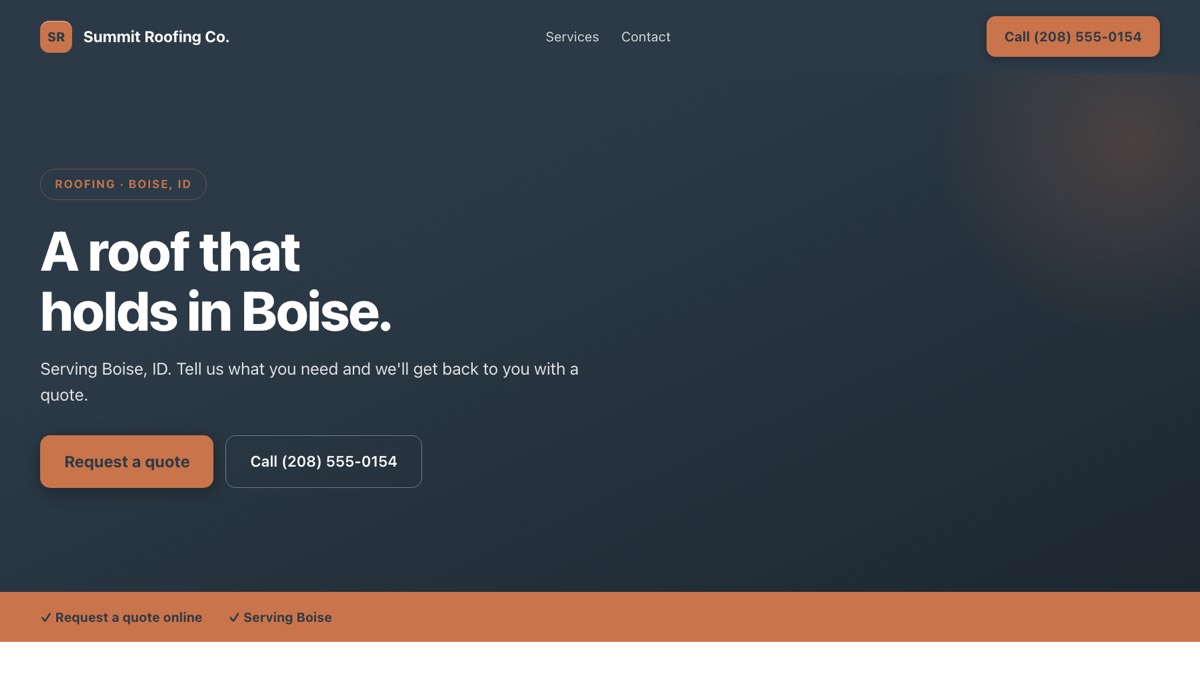
What Onelios does for you
- Your website: Type your business name, trade and city and the AI drafts a headline, a line under it and your services. Read every word before you publish; the AI can get things wrong.
- Roof photos: Upload photos of finished roofs from your phone (JPEG, PNG or WebP, up to 5 MB each) with an optional caption. The site shows your 24 most recent; until you add one there is no gallery.
- Quote requests: Every request is saved in your inbox and an email alert to you is attempted. Reply to that alert and your answer goes straight to the homeowner, if they left an email address.
- Inspection times: Once you save your working hours, homeowners can request a time. Each one is a request you confirm; outside calendars and overlapping jobs are not checked.
- Reviews: Onelios emails a past customer a private link and they write the review themselves; it publishes on your site. If they reply to that email, the reply comes to you.
What should a roofing website show before a homeowner calls?
A roofing website should show who you are and where you work, a way to call or ask for a quote, photos of roofs you finished, reviews your customers wrote, and your license number where your state requires it in ads. The Federal Trade Commission tells homeowners to confirm a contractor's license and insurance, so make both easy to find.
The Federal Trade Commission's advice to homeowners after weather emergencies reads like a checklist for your website. It tells them to check a contractor's license with their state or county, ask for proof of insurance, get written estimates from more than one contractor that describe the work, materials, completion date and price, and search a contractor's name with words like “scam,” “review” or “complaint.” Its warning signs include a contractor who says no license is needed, wants everything paid up front, or asks the homeowner to sign over the insurance check.
So say plainly what your written estimate includes, offer a copy of your certificate of insurance on request, and never ask for the insurance check. Onelios gives you the pieces: a headline and a line under it of up to 240 characters that you can edit yourself, your services with a line about each, a gallery of your own photos with optional captions, and reviews homeowners write through a private link. Pick photos that show what a homeowner cannot easily check from the ground: a straight ridge line, neat flashing around a chimney, clean gutters and a tidy yard at the end of the job.
Free to build and publish. No card. See what is included
Do I have to put my license number on my roofing website?
In some states, a roofing website must show your license number. California requires a licensed contractor's number in all advertising, and its contractors board counts websites; roofing there is the C-39 license. Florida requires a contractor's registration or certification number in every advertisement, “regardless of medium.” Other states set their own rules, so check with your state's licensing board.
California's Business and Professions Code section 7030.5 requires the license number in contracts, subcontracts, calls for bid and “all forms of advertising.” The Contractors State License Board lists “any website or post that solicits business on the Internet” as advertising and says the civil penalty for a first offense is $100 to $1,000. Its advertising guidelines add two rules a website can break: advertise only work within your license classification, and do not say you are bonded. Roofing is classification C-39 on the board's list.
Florida's statute section 489.119 says a contractor's registration or certification number must appear in each advertisement “regardless of medium.” For a first offense the board issues a notice of noncompliance, and it may fine a contractor who has not corrected the problem within 30 days.
Onelios has no separate license field, and the AI is instructed not to add licenses or other credentials you did not give it. Type the number yourself into the line under your headline, where it sits near the top of your home page, then check it on the published site and again after any AI rewrite of your wording. Service pages do not show that line and their wording cannot be edited, so the number will not appear on them.
What are the rules for insurance-claim wording on a roofing website?
In Texas, a roofer doing the work may not advertise, on a website or elsewhere, that it will act as the homeowner's public adjuster, or offer to waive, rebate or absorb the deductible. In Florida, a contractor may not solicit homeowners with a message inviting a roof-damage claim unless it carries three statements about the deductible and insurance fraud.
The Texas Department of Insurance says a roofer who is also doing the work may not act as the homeowner's public insurance adjuster, and may not advertise that either; Texas insurance rules define an advertisement to include a website. It asks contractors to make sure their websites, ads and other materials do not say or imply it, and gives examples of improper wording: offering to negotiate a settlement or file the claim, promising to recover “every dime you are owed,” or offering to help homeowners avoid “incorrect settlement pricing.” Offering to waive, rebate or absorb a deductible is illegal there too, and contracts of $1,000 or more involving an insurance settlement must carry a notice that the homeowner pays the deductible.
Florida's section 489.147 treats as a prohibited advertisement any written or electronic communication from a contractor that encourages a homeowner to get in touch about a roof-damage insurance claim without three statements, in type at least 12 point and at least half the size of the largest type used: the homeowner pays the deductible; a contractor knowingly or willfully paying, waiving or rebating it with intent to defraud is insurance fraud punishable as a third-degree felony; and intentionally filing a claim with false, incomplete or misleading information is too. The statute names emails and door hangers among its examples. It also bars offering gifts, cash or a deductible waiver in exchange for a roof inspection or a claim, and advising a homeowner on what their policy covers unless you hold a public adjuster license, with fines of up to $10,000 per violation. And a homeowner who signs a roof contract within 180 days of the events covered by a governor's state-of-emergency declaration for their area may cancel within 10 days or by the official start date, whichever comes first.
In practice: a storm page goes live as soon as Onelios writes it, and you can remove it but not edit its wording, so read it straight away. Onelios campaign emails set their text at 15 pixels, about 11 point, under Florida's 12-point minimum, so do not use them to invite a roof-damage claim in Florida. The AI is instructed not to promise anything you did not tell it, but it can still make mistakes. This is a summary of what these agencies and statutes say, not legal advice.
How do I have a storm-damage page ready before storm season?
In Onelios, ask for “a page for storm damage inspections.” It is written and published at once, with an introduction, what's included, common questions and a Request a quote button, linked from your home page. The page can only appear in Google once your site is on a domain you own, so connect one before storm season.
The free Onelios address is kept out of Google on purpose. On your own domain, the storm page is listed in your site's sitemap (yourdomain.com/sitemap.xml) with your home page and other service pages, but a sitemap is not a promise that Google will list the page, and nobody can say when it will. That is the reason to publish it in a quiet month rather than the week the hail arrives. Connecting a domain you already own is free; Onelios does not sell domains.
Two limits to plan around. The page has no form of its own: its Request a quote button takes the homeowner to the form on your home page. That form asks for a name, a phone number or email, the service (optional) and a message of up to 2,000 characters, with no photo upload, so when a homeowner writes about a leak, ask for a photo of the stain or the damage in your reply.
Every request is saved in your inbox whether or not the email alert reaches you, so check the inbox on busy days. Homeowners can request an inspection time only after you save your working hours; each is a request you confirm, and Onelios does not check an outside calendar or catch two jobs that overlap. It sends no text messages.
How does Onelios compare with Roofr Sites and Jobber?
Onelios is free right now and needs no card. Roofr Sites, an add-on for any Roofr plan, is listed at $99 a month, and Jobber includes its website builder in every plan, with Core at $49 a month billed monthly. Both come with business software Onelios does not have. Prices read on their own pages on September 23, 2026.
Roofr's own pages, read September 23, 2026: Roofr Sites costs $99 a month, or $85 a month billed yearly, for hosting and managed updates; Roofr lists it as a beta and says pricing for future customers may change. You plan about an hour for a kickoff session, its AI writes the copy and people at Roofr review it, and the site features your Google reviews. Roofr's Instant Estimator, which can be embedded on the site, is a separate add-on at $149 a month, or $125 billed yearly, and the rest of Roofr is roofing software such as measurement reports and a job board.
Jobber's own pages, read September 23, 2026: its website builder generates pages from the services you offer and is included with every Jobber plan at no additional cost, and the Core plan is $49 a month with no commitment, less when paid yearly. The site can highlight your Google reviews, take request forms and offer online booking.
What Onelios does not have: roof measurements, instant estimates, invoicing, payments, text messages or staff logins, and it does not pull in your Google reviews; you can add a review a customer gave you elsewhere by hand. If you already pay for Roofr or Jobber, their site sits next to software you use every day; if you want a site without new software to learn, Onelios costs nothing today. The full list of limits is on our What it does page, and the price is in the pricing section of our home page.
Built for roofing work
Your site starts with these services listed — ask for a full page for any of them:
- Roof repair
- Roof replacement
- Storm damage
- Emergency tarping
- Gutters and drainage
- Inspections
Free to build and publish. No card. See what is included
Common questions
Is there a free website builder for a roofing company?
Onelios is free right now: building, publishing, connecting a domain you already own and every tool, with no card. A small “Site by Onelios” line stays at the bottom of the site. For comparison, Roofr Sites is $99 a month, and Jobber includes its website in every plan, with Core at $49 a month billed monthly, both read on their own pages on September 23, 2026.
Will my roofing website show up on Google?
Not on the free Onelios address, which is kept out of Google on purpose. On a domain you own it can appear, and your pages are listed in its sitemap, but Google decides whether and when, and nobody can promise a position. That is why a storm-damage page belongs on your site well before the season, not during it.
Do I need my license number on my roofing website?
In California and Florida, yes: California requires the license number, and Florida the registration or certification number, in advertising, and California's contractors board counts websites. Other states set their own rules, so check with your state's licensing board. Onelios has no license field, so type the number into the line under your headline; service pages do not show that line.
Can my roofing website offer to handle the insurance claim?
Not in Texas: its Department of Insurance says a roofer doing the work may not act as, or advertise as, the homeowner's public adjuster, and offering to waive or absorb a deductible is illegal. In Florida, a contractor without a public adjuster license may not adjust a claim or advise on what a policy covers, and may not offer gifts or a deductible waiver for a roof inspection or claim. This is a summary, not legal advice.
Can homeowners send photos of roof damage through the form?
No. The quote form takes a name, a phone number or email, the service and a written message, with no photo upload. Every request is saved in your inbox and an email alert to you is attempted. If the homeowner left an email, replying to that alert answers them directly, so ask for the photos there.
How is Onelios different from Roofr Sites?
Roofr Sites is $99 a month, or $85 billed yearly, with a kickoff session, people reviewing the AI's copy, managed updates, your Google reviews featured and an optional instant-estimate add-on, alongside Roofr's roofing software. Onelios is free right now, you review and edit the AI's draft yourself, and it has no estimating or measurement tools. Prices read September 23, 2026.
Sources
- Texas Department of Insurance: Roofing and insurance, know the law (page last updated March 24, 2025), read
- California Business and Professions Code section 7030.5, read
- California Contractors State License Board: Advertising guidelines for contractors, read
- California Contractors State License Board: license classifications (C-39 Roofing), read
- Florida Statutes 2026, section 489.147: prohibited property insurance practices, read
- Florida Statutes 2026, section 489.119(5): registration or certification numbers in advertising, read
- Federal Trade Commission: How to avoid scams after weather emergencies and natural disasters, read
- Roofr: Roofr Sites, read
- Roofr: pricing and plans, read
- Jobber: website builder, read
- Jobber: pricing, read
- Onelios: what it does and does not do, read
- Onelios: pricing, read
Other trades we build for
Plumbers, Landscapers, Contractors, HVAC companies, Electricians, Dentists, Salons & beauty, Cleaning services, Auto repair, Pest control, Locksmiths, Garage door repair, Tree service.
Build a free draft for your roofing company. Review it before publishing. Get started · See pricing · What you get · Talk to us