Onelios is a free website builder for tree service companies: the AI drafts your site from your business name, trade and town, you add photos of jobs you finished, quote requests land in one inbox with an email alert attempted, and reviews your customers write themselves publish on your site.
Researched by the Onelios team at KCF LLC (about us) from the primary sources listed at the end of this page. Checked . A summary to help you check your own rules, not legal advice.
Free to build and publish. No card. See what is included
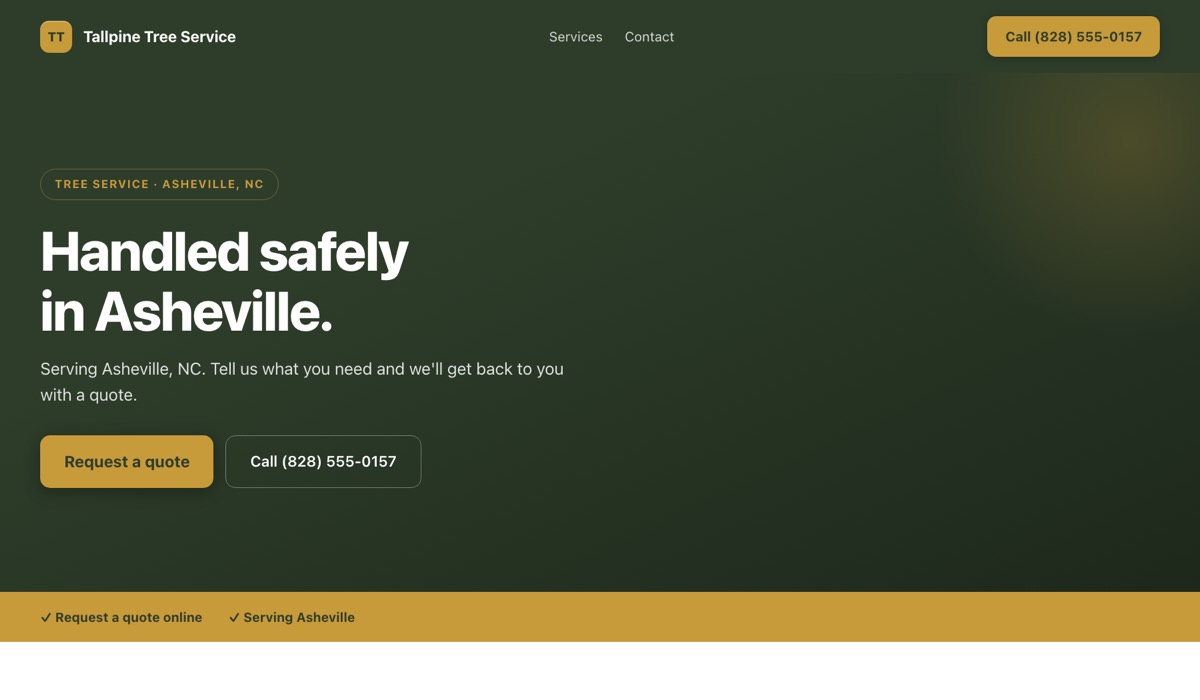
What Onelios does for you
- Your website: Type your business name, pick Tree service, and add your town. The AI drafts a headline, a line under it and your services. Read every word before you publish; the AI can get things wrong.
- Job photos: Upload finished jobs and cleared yards from your phone (JPEG, PNG or WebP, resized in your browser before upload) with a short caption. Your site shows the 24 most recent; with no photos there is no gallery.
- Quote requests: Every quote request lands in your Onelios inbox, and Onelios tries to email you an alert as well. If the customer left an email address, replying to that alert answers them directly.
- Estimate visits: Once you save your working hours, customers can request a time for you to come and look at the tree. Each is a request you confirm, and Onelios will not spot a clash with another calendar or an overlapping job.
- Reviews: Pick past customers and Onelios emails each one a private link in your business's name. They write the review in their own words, and it publishes on your site. Requests go by email only, and if the customer replies, the reply comes to you.
- Monday email: A weekly count of the quote requests, online bookings and new reviews that came through your site, with suggestions for the week. Phone calls never pass through Onelios, so they are not counted.
What does a homeowner check on a tree service website before calling?
Homeowners are told to check whether a tree company is insured, licensed where the law requires it and qualified, and to look at past work. The Tree Care Industry Association says to ask for current certificates of liability and workers' compensation insurance, check credentials, get estimates in writing and not pay in advance. Make each easy to find.
The industry's own hiring advice reads like a checklist for your home page. The Tree Care Industry Association (TCIA) tells homeowners to ask to see current certificates of liability and workers' compensation insurance, ask for references, get estimates in writing with a written work order, ask about ANSI standards, and insist that climbing spikes are used only on a tree that is coming down, because spikes damage the tree. It also tells them to check whether their city requires arborist licensing, and warns that if a tree company has no insurance or is not a legal company, the homeowner could be held responsible as a contractor.
Credentials can be checked, so make yours easy to confirm. The International Society of Arboriculture (ISA) runs a public Find an Arborist directory for finding and verifying ISA credential holders. Listing there is voluntary, so if you hold a credential, check that your listing is visible. New Jersey's Board of Tree Experts warns that many homeowner policies will not cover injuries or damage done by an under-insured tree care contractor, which may leave the cost with the homeowner.
The insurance question exists because the work is dangerous. An April 2023 article in TCI Magazine, published by TCIA, reported a preliminary Bureau of Labor Statistics estimate of 110 deaths per 100,000 tree trimmers and pruners, about 30 times the all-industry average. For comparison, the Bureau's rate for all U.S. workers in 2024 was 3.3 deaths per 100,000 full-time equivalent workers.
Onelios has no insurance or credential field, and the AI is instructed not to claim a license, a credential or anything else you did not tell it, though it can still make mistakes. Type them in yourself: the line under your headline takes up to 240 characters and each service line up to 220, for example “Liability and workers' comp insured; certificates on request” or “Pruning by an ISA Certified Arborist”, and only if it is true. Then check the published page.
Free to build and publish. No card. See what is included
Which states want a license number on a tree service website?
At least two states require one. California requires a licensed contractor's number in all advertising, websites included, and its C-49 Tree and Palm classification covers tree work. New Jersey requires a registered tree care business to show its NJTC registration number in any tree care advertising. Other states set their own rules, so ask your state board.
California's Business and Professions Code section 7030.5 requires a licensed contractor's number in contracts, calls for bid and “all forms of advertising.” The Contractors State License Board counts “any website or post that solicits business on the Internet” as advertising, with a civil penalty of $100 to $1,000 for a first offense. Its C-49 Tree and Palm Contractor classification covers planting, maintaining and removing trees and palms, including pruning, stump grinding and guying. The board's guidelines also say to advertise only work within your classification and not to say you are bonded. Section 7048 exempts small jobs under $1,000 in total that need no building permit, but not for someone who advertises in a way that suggests they are a contractor, or who employs others to do or help with the work.
New Jersey's Board of Tree Experts says a registered business must put its name and registration number in any form of tree care advertising, written as the words “NJTC Registration” with the number after a pound sign, and may advertise only the services its licensed staff are licensed to perform. Breaking those advertising rules can cost a business its registration or bring civil penalties. Registration requires at least one licensed tree expert or tree care operator working full time, $1,000,000 of general liability insurance or a letter of credit, and workers' compensation coverage. The number must also be at least three inches high on at least two sides of every service vehicle.
Connecticut requires an arborist license to advertise, solicit or contract to do arboriculture, which its law defines to include pruning, trimming and bracing trees, and arborist businesses have had to register with the state's Department of Energy and Environmental Protection since October 2013. Other states and many cities set their own rules. This is a summary of what these agencies say, not legal advice.
On Onelios, type the number into the line under your headline, near the top of your home page. Service pages work differently: the AI writes them from your business name, trade, town and the page title, they do not show that line, and their wording cannot be edited line by line. If your state wants the number in every advertisement, ask your board whether that covers each page before you add one.
How does a tree service website catch storm and emergency calls?
A tree service website catches storm calls with a Call button and an emergency page that exists before the storm. Give Onelios a phone number and your home page shows the Call button at the top. Ask for the emergency page in a calm month: it can appear in Google only on a domain you own.
The storm caller and the planned-removal customer read the same site differently. Someone with a limb through the carport roof wants your number at a glance; someone planning next month's removal reads the insurance line, the photos and the reviews. The home page serves the first with its Call button and the second with everything under it, and a page per service carries the detail.
Ask for the emergency page in plain words, such as “add a page for emergency tree removal”, and Onelios writes and publishes it with an introduction, a “What's included” list, common questions and a Request a quote button, linked from your home page. On a quiet week the Monday email suggests the same page. The AI knows only your business name, trade, town and the page title, and it is instructed not to promise response times such as 24/7, so say whether you answer at night in your emergency removal service line on your home page, which you can edit. If the page reads wrong, remove it and ask again.
Say what you do when a tree is on a wire. OSHA's safety card for tree care crews says to assume every power line is energized and to keep work at least 10 feet away, or call the power company to de-energize and ground the line. A caller with a tree on the line to the house should know whether you will come out or wait for the utility.
Your site's free Onelios address is deliberately kept out of Google's results. Once your own domain is connected and verified, the emergency page is listed in that domain's sitemap with your other pages, but a sitemap is not a promise of a listing, and nobody can say when Google will show it. That is the reason to publish it well before storm season. Hooking up a domain you already own costs nothing, and Onelios does not sell domains.
The quote form asks for a name, a phone number or email, the service and a message, with no photo upload, so when someone writes about a cracked limb, ask for a picture in your reply. Onelios tries to email you each request, and the request stays in your inbox even if that email never arrives; when the customer left an email, replying to the alert reaches them. Onelios sends no text messages, and calls to your phone never pass through it.
What should a tree service website say about estimates and cleanup?
A tree service website should say what the price includes and how the tree comes down: whether hauling away wood and brush, raking up and stump grinding are included, and whether a tree near a building is lowered in sections. The Tree Care Industry Association tells homeowners to get estimates in writing and insist on a written work order.
Two estimates for one tree can look far apart when one includes cleanup and stump grinding and the other does not, or when one crew plans to lower the tree piece by piece over a roof and the other plans to drop it whole. The homeowner sees only the totals unless your site explains what yours covers. TCIA's advice goes further: a signed contract stating the cost, the dates and exactly what is to be done, and no payment in advance.
After storms, the Federal Trade Commission tells homeowners to be skeptical of anyone promising immediate cleanup, to get estimates from more than one contractor, to walk away from anyone who wants cash up front, and not to make the final payment until the work is done. Onelios takes no payments or deposits, so nothing on your site asks for money; say on it, in your own words, how and when you are paid.
Put your usual inclusions in your service lines, which you can edit, for example “Removal with brush and wood hauled away; stump grinding priced separately.” Then let photos do the rest. The yard after you leave, the stump ground out, a lawn without ruts: those answer what the property will look like afterward. A tree being lowered in sections over a shed shows why your price includes rigging. Add a caption of up to 160 characters, such as “Oak over the garage, lowered in sections, stump ground, yard raked.”
How does Onelios compare with Zarla, Grow Local and Jobber for tree services?
Onelios is free right now, including publishing and connecting a domain you already own. Zarla is free to build, but publishing starts on Premium at $29 a month billed month to month; Grow Local is $99 a month; Jobber includes its website builder in every plan, with Core at $49 a month billed monthly. Prices read September 23, 2026.
Zarla's own pages, read September 23, 2026: building and previewing a tree service site is free, and going live starts on Premium at $29 a month billed month to month, or $10.99 a month on a 36-month plan paid up front ($395.64); the Business plan is $49 a month billed month to month. Its tree service page lists online booking with a deposit, quote request forms, invoices paid online and built-in lead tracking.
Grow Local's tree service page, read the same day: no contract, a free preview without a card, and $99 a month once you publish. It generates a page for every service in every city you serve, frequently asked questions covering pricing, insurance and ISA certification, and call buttons for storm work.
Jobber, read the same day: its website builder generates pages from the services you offer and is included with every Jobber plan at no additional cost; Core is $49 a month billed monthly with no commitment, and less on an annual plan. The site takes request forms and can show your Google reviews. Durable, for comparison: its Free plan is a private preview, and its Launch plan, $25 a month billed monthly, adds your own domain.
What Onelios does not have: deposits, invoicing, online payments, crew scheduling, estimating tools, text messages or staff logins. It does not pull in Google reviews, though you can add one a customer gave you elsewhere by hand, and you cannot reply to reviews from it. It writes a service page when you ask for one, not one per town on its own. If you already run your jobs in Jobber, its site sits next to software you use every day; if you want a website and nothing else to learn, Onelios is free today. Our What it does page lists what Onelios does and does not do; the price sits in the pricing section of our home page.
Built for tree service work
Your site starts with these services listed — ask for a full page for any of them:
- Emergency removal
- Tree removal
- Trimming and pruning
- Stump grinding
- Storm preparation
- Health assessment
Free to build and publish. No card. See what is included
Common questions
Is there a free website builder for a tree service?
Onelios charges nothing right now for building, publishing, connecting a domain you already own, or any tool, and asks for no card. The free site carries a small “Site by Onelios” credit at the bottom. Zarla, which also builds tree service sites, is free to build but going live starts at $29 a month billed month to month, or $10.99 a month on a 36-month plan paid up front (read September 23, 2026).
Will my tree service website show up on Google?
The free Onelios address stays out of Google by design. Move the site to a domain you own, which is free to connect, and it becomes eligible: that domain's sitemap lists your home page and service pages. Google still chooses whether and when to show them, so get your emergency removal page up before storm season.
Do I need a license number on my tree service website?
In California and New Jersey, yes. California requires a licensed contractor's number in all advertising, websites included, and C-49 Tree and Palm is the classification that covers tree work. New Jersey requires the words “NJTC Registration” and your number in any tree care advertising. Onelios has no license field, so type the number into the line under your headline.
How do I show my insurance and ISA certification?
Type them yourself into the line under your headline or a service line, and only what is true; the AI is instructed not to add credentials you did not give it, and it can still make mistakes. The Tree Care Industry Association tells homeowners to ask for certificates of liability and workers' compensation insurance, so say they are available on request if they are.
Can customers send a photo of the tree through the form?
No. The form has four fields (name, phone or email, the service, and a message) and no upload. Ask for the picture when you answer. If they gave an email address, replying to the alert Onelios attempts to send you goes straight to them; if they gave only a phone number, call them back.
How is Onelios different from Grow Local for a tree service?
Grow Local has no contract and charges $99 a month once you publish; it generates a page for every service in every city you serve, with FAQs on pricing, insurance and ISA certification. Onelios is free right now and writes a service page when you ask for one. Its AI is instructed not to add credentials, so you type your own. Grow Local's price was read on its own page on September 23, 2026.
Sources
- Tree Care Industry Association: Hiring a tree care company (page updated May 5, 2023), read
- International Society of Arboriculture: Find an ISA-credentialed arborist, read
- TCI Magazine (Tree Care Industry Association): Tree-work safety by the numbers, John Ball, April 1, 2023, read
- U.S. Bureau of Labor Statistics: Census of Fatal Occupational Injuries summary, 2024 (released February 19, 2026), read
- New Jersey Board of Tree Experts: What consumers should look for, read
- New Jersey Board of Tree Experts: Advertising by business, read
- New Jersey Board of Tree Experts: Information for businesses, read
- California Business and Professions Code section 7030.5, read
- California Business and Professions Code section 7048 (as amended, effective January 1, 2026), read
- California Contractors State License Board: Advertising guidelines for contractors, read
- California Contractors State License Board: C-49 Tree and Palm Contractor, read
- Connecticut Department of Energy and Environmental Protection: Commercial arborist license, read
- OSHA: Tree care work QuickCard (OSHA 3752), read
- Federal Trade Commission: How to avoid scams after weather emergencies and natural disasters, read
- Zarla: pricing, read
- Zarla: tree service website builder, read
- Grow Local: tree service website builder, read
- Jobber: website builder, read
- Jobber: pricing, read
- Durable: pricing, read
- Onelios: what it does and does not do, read
- Onelios: pricing, read
Other trades we build for
Plumbers, Landscapers, Contractors, HVAC companies, Electricians, Dentists, Salons & beauty, Cleaning services, Roofers, Auto repair, Pest control, Locksmiths, Garage door repair.
Build a free draft for your tree service company. Review it before publishing. Get started · See pricing · What you get · Talk to us